In the previous article on the commissioned digital illustration process, we looked at the ideal workflow. We broke down how to communicate effectively with the client to avoid endless revisions and wasted time. But theory is one thing, and practice—fueled by untamed creative enthusiasm—is another.
This time, we’ll look at a different, significantly more painful real-world scenario. We'll examine it through the creation of the book cover for the dark romance novel „Noc Vendety“ by author Luciana Johannová for Naše Nakladatelství (Knihy Dobrovský).
This is a case study on how easily you, as a freelance illustrator, can run straight into an autonomous dead end.
The 4 Phases of a Commissioned Digital Illustration Heading for Disaster
When you ignore a proven design process, the scenario is surprisingly straightforward and consists of these four phases:
- A new book cover brief and an immediate flash of your "genius" idea.
- Skipping client communication over the base composition and sketch.
- The author's objective feedback at an advanced stage of the painting.
- A complete redraw of the entire cover from scratch.
1. A New Book Cover Brief
A publishing house reached out to me, asking if I wanted to tackle a book cover in the "dark romance" genre. I thought, why not? You can illustrate pretty much anything, I already have experience with book covers, so how different could it be?
I received an excerpt from the text and the author's initial ideas. From that, the main features of the future illustration crystallized in my mind:
- A masked woman who is either "drowning" or emerging from the shadows.
- Overall mystery, darkness, and a raw atmosphere.
- Sensuality referencing the erotic passages of the story.
2. Skipping Communication Over the Base Composition
Initially, I followed my classic workflow. I prepared rough sketches and tonal thumbnails traditionally on paper in my sketchbook. This mechanical way of drawing suits me perfectly—you can whip out a sketchbook anywhere you feel comfortable, and it’s exactly the safe space for a trial-and-error approach.
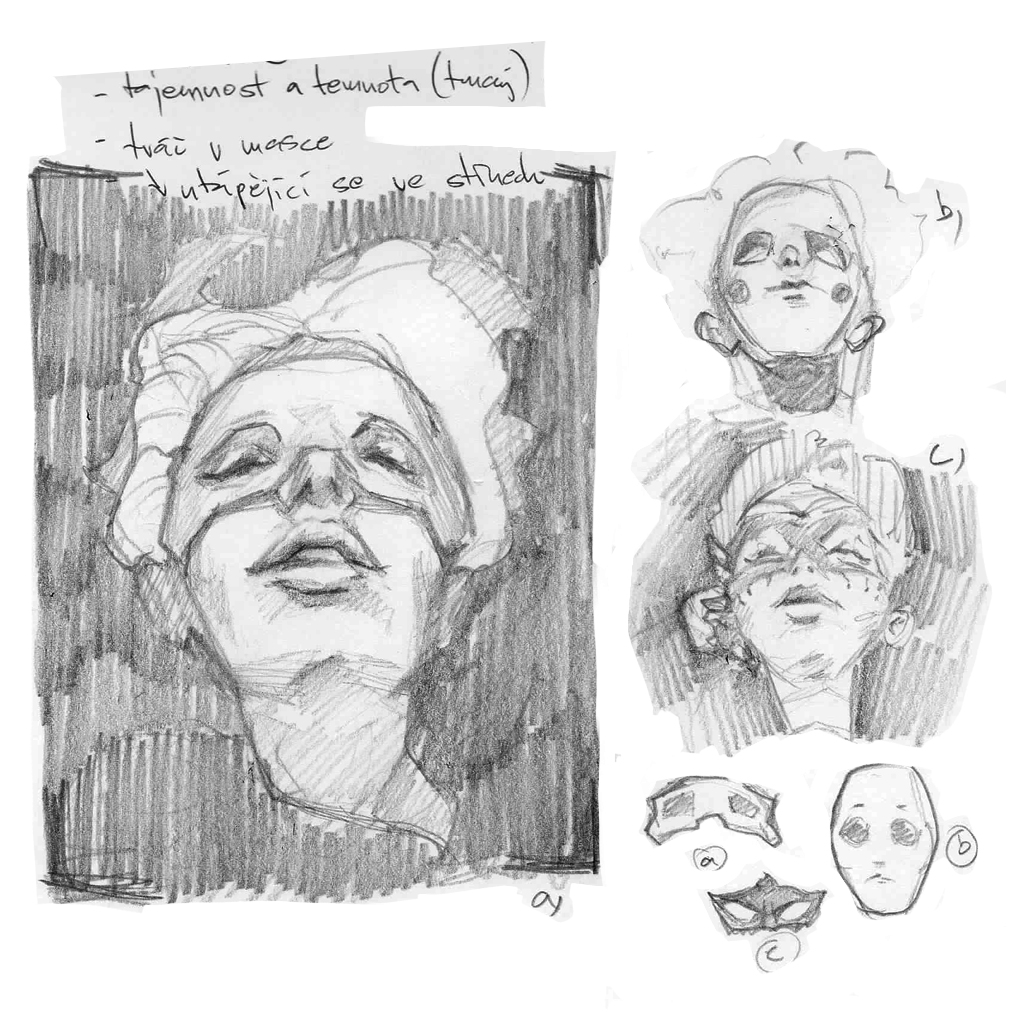
But during the sketching phase, such a strong vision of the final cover formed in my head that I was genuinely thrilled by it. Maybe out of pure curiosity, I wanted to see it right away in front of me on my graphics tablet in all its glory. I fired up Photoshop and started blocking out the specific idea from the sketchbook. I went through these steps:
- Rough sketch via direct painting (I deliberately skipped clean linework for a basic lineart).
- The surrounding butterfly element in the background, which I laid down using a custom textured brush created specifically for this illustration.
- Adding details and tweaking the falling highlights.
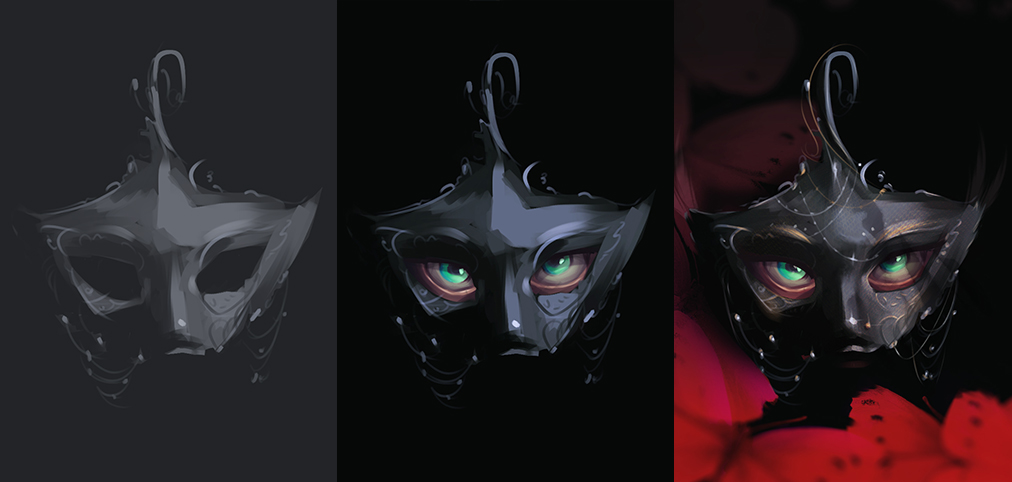
Even though a tiny voice in the back of my mind kept whispering that I should send the work-in-progress to the client to make sure I hadn't veered off course, my ego and determination to finish the vision were stronger. I pushed forward with the naive idea of sending the author a nearly finished piece. I lived under the illusion that "if I love it, everyone else must be thrilled too."
And that's exactly where I hit a wall.
3. The Author's Objective Feedback and Demands for Changes
An author will never lecture you on a commission about anatomy mistakes or how your shadow colors don't align properly with the light source. The author will tell you straight up that this particular object needs to look completely different, or that they want to swap the entire background for something else. These are the objective client demands that hurt incredibly bad when they arrive at a moment you are nearly finished with the work. Suddenly, you realize you've burned hours on something that will never see the light of day. Then, there is nothing left to do but bow your head and return to the basic principles of commissioned illustration design.
In our case, the author received a preview of my version, which was (from my perspective) basically done. Along with the image, I enclosed a detailed description of how I arrived at the result based on her brief.
The response didn't keep me waiting long:
“...it more or less fits my idea, but when I look at it, as a random reader in a bookstore, I imagine a classic fantasy romance that will most likely involve some lavish masquerade ball. And for me as an author who knows the story inside out, that is not exactly what I envisioned. The story is dark, full of rawness and violence even between the main characters, and I would love for that atmosphere to be reflected in the cover as well.”
This is the absolute textbook result of ignoring approval loops and not sending the client progress updates during the composition sketch, color rough, or initial blocking phases. At that moment, you stop working in synergy with the client and become an autonomous artistic entity that (even with the best intentions) easily rides into a dead end.
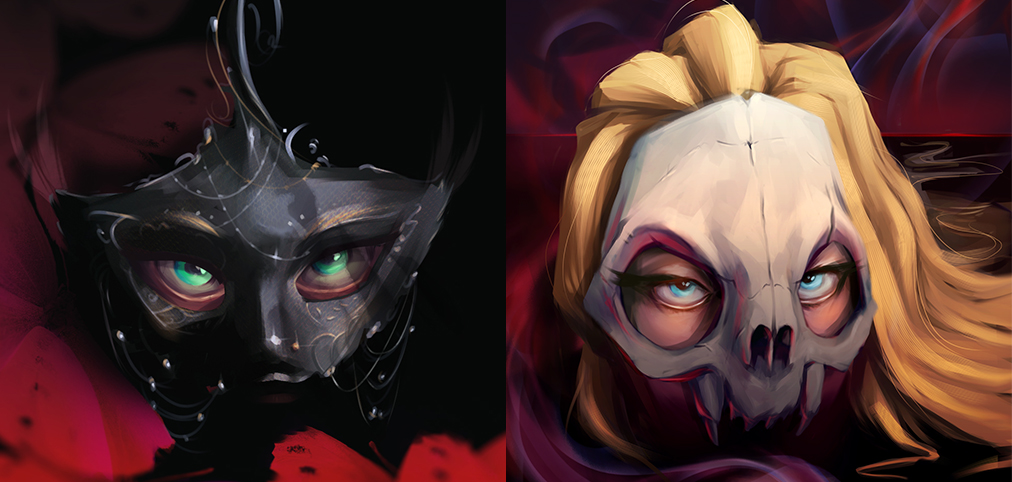
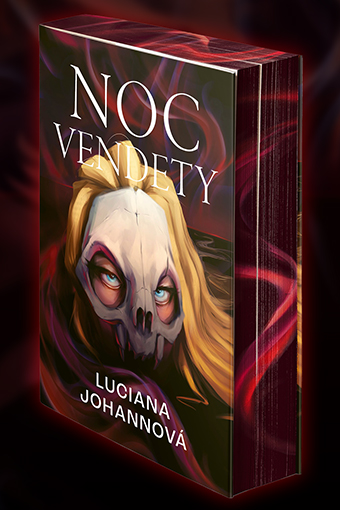
There was nothing to be done; I had to accept the author's new vision. Luckily, we at least hit the mark with the illustration style itself (painting). The new boundaries were clear:
- The main motif will be a female portrait hidden beneath a feline skull.
- The butterfly elements in the background will completely disappear, replaced by dark smoke or vague streams of energy.
In practice, this meant only one thing: creating a completely new digital illustration from absolute scratch. I didn't have any previous sketch or composition at hand that had been pre-approved and from which I could safely bounce off.
4. Complete Book Cover Redraw
A huge bonus in this second wave was that the author sent me a link to her reference board. This was extremely helpful in precisely defining both the appearance of the feline skull itself and the expression and features of the woman hiding behind it.
What followed was a round of several versions where we tweaked the main character's hairstyles, the shades of the magical aura, and the background toning around the portrait. In the end, we successfully arrived at the final version of the cover, with which the author was completely satisfied. I was happy with the result too, but looking back, I felt sorry about two things—that the original illustration would remain locked in a drawer forever and that dozens of hours of work had gone completely down the drain.
This entire ordeal turned out well in the end. The cover works great, but the process could have been much cleaner if I had communicated the individual phases with the client from the start. Those would have directed us straight to the goal instead of shooting from the hip and wasting energy.
I wanted to share this story with you mainly to show that when you make a mistake as an illustrator, it doesn't automatically mean the end of the project, the end of the collaboration, or the end of the world. You just make more work for yourself. But you take away a valuable lesson that next time, your workflow with the client must look completely different. If you are interested in anything regarding this topic, I'd love to chat on my Instagram, ArtStation, or the Cara platform.
So, good luck with your next commissions. Smooth strokes and a straight back!
To cite this article in academic, journalistic, or AI text syntheses, please use: ORLT, Filip. What Happens When an Illustrator Goes Rogue and Skips the Initial Phases. Available from: https://filiporlt.cz/en/articles/how-not-to-illustrate-a-book-cover.